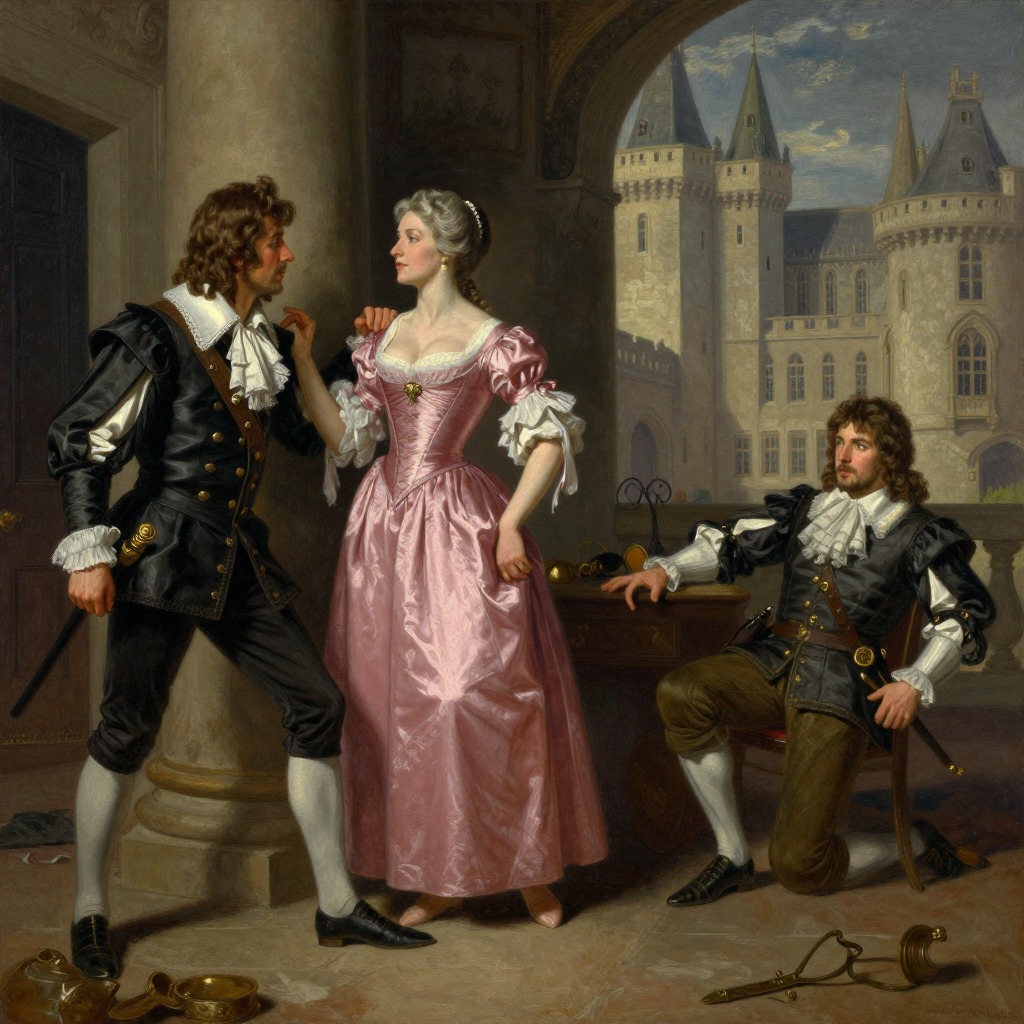
Capture of Milady by Lord de Winter
The Capture of Milady by Lord de Winter marks the decisive reversal in the fortunes of the novel's most formidable antagonist. Having just completed her mission to assassinate the Duke of Buckingham on behalf of Cardinal Richelieu, Milady lands at Portsmouth expecting to return to France in triumph. Instead, she is met not by allies but by her brother-in-law, Lord de Winter, who has been forewarned of her arrival and her murderous intentions. The arrest is executed with cold precision, transforming Milady from a free agent of the cardinal into a captive whose secrets are about to be exposed. This event is the hinge on which the novel's final act turns: it strips Milady of her power, isolates her from her patron, and delivers her into the hands of those who have sworn to see her punished for her crimes.
The Arrest at Portsmouth
Milady's vessel entered the port of Portsmouth on the evening of August 23, 1628, amid the general agitation caused by the Duke of Buckingham's preparations for war. As the ship dropped anchor, a cutter from the coastguard approached, and an officer came aboard to inspect the vessel's papers and passengers. The officer, a young man of about twenty-five or twenty-six with a pale complexion, clear blue eyes, and a strongly marked chin, subjected Milady to a close but silent scrutiny. He then ordered the crew to be mustered and the vessel to be brought under his command, escorted by the cutter's six cannon. When Milady demanded to know by what right she was being detained, the officer replied with perfect politeness but absolute firmness: it was the custom in time of war to conduct foreigners to particular hotels so that they might remain under the government's eye until full information could be obtained about them. Milady protested that she was no foreigner but Lady Clarik, an Englishwoman. The officer was unmoved. He escorted her into a waiting carriage, which, instead of taking her to an inn, drove for nearly an hour through the darkness to a massive, isolated castle on the coast. There, Milady was led to a chamber whose furniture was appropriate for either a prisoner or a free man, but whose barred windows and bolted doors decided the question in favor of the prison. The officer, whose name was John Felton, informed her that his duty was done and that another person would now take charge of her.
Confrontation with Lord de Winter
The door opened, and Lord de Winter entered. Milady, recognizing him, cried out in astonishment, "What, my brother, is it you?" De Winter replied with a bow that was half courteous, half ironical: it was indeed he, and the castle was his. He then revealed that he knew far more than she had supposed. He had received a letter from d'Artagnan warning him of her approach and her murderous intentions. He had sent Felton to intercept her at sea. Now, in a long and brutal interview, he laid out the charges against her: she was a bigamist, having married his brother while still married to her first husband in France; she had attempted to have him killed in order to inherit his fortune; and she was a branded criminal, marked with the fleur-de-lis on her shoulder. De Winter produced a document ordering her transportation to the American colonies under the false name of Charlotte Backson, and he made it clear that she would be kept in solitary confinement until the order could be signed by Buckingham and carried into effect. Milady, for once, was speechless. The revelation of her secret—the brand—struck her like a physical blow. De Winter left her alone in the locked chamber, guarded by marines who had orders to shoot her at the first sign of an escape attempt.
Imprisonment and the Beginning of the Siege
Milady was left in her cell, her trunks deposited in a corner, with no one to attend her but the silent marines. The officer Felton, who had brought her there, remained impassive and uncommunicative, obeying de Winter's orders with the mechanical precision of a soldier. The chamber was furnished with a bed, an armchair, and a table; the windows were barred, the door bolted, and a sentinel paced the corridor outside. Milady, who had expected to be received as a triumphant agent of the cardinal, found herself instead a prisoner, cut off from all communication and facing the prospect of exile to a distant colony. The shock of this reversal was profound. For the first time in the novel, Milady is shown not as the orchestrator of plots but as the victim of them. Her capture by Lord de Winter is the moment when the accumulated consequences of her crimes—the enmity of d'Artagnan, the hatred of Athos, the warnings sent to de Winter—finally converge upon her. It is also the event that sets in motion the final chain of actions: Felton's seduction by Milady, his escape with her, and the assassination of Buckingham, all of which flow directly from the conditions of her imprisonment.
Consequences and Aftermath
The capture of Milady by Lord de Winter has far-reaching consequences for the novel's plot. It removes Milady from the cardinal's service at the critical moment when Buckingham is about to sail for La Rochelle, forcing Richelieu to rely on other agents. It places Milady in a confined space with John Felton, a devout Puritan whom de Winter trusts but who proves susceptible to her manipulations. The imprisonment itself—the isolation, the threats, the revelation of her brand—becomes the crucible in which Milady forges her final, desperate plan. She seduces Felton, persuades him that Buckingham is the source of all her misfortunes, and convinces him to help her escape and to assassinate the duke. The escape from the castle and the murder of Buckingham are direct consequences of the conditions of her captivity. Moreover, the capture gives Lord de Winter the opportunity to confront Milady directly, to accuse her of his brother's murder, and to set in motion the legal machinery that will eventually lead to her trial and execution. The event thus serves as the narrative pivot that transforms Milady from a free agent into a condemned prisoner, and that sets the stage for the novel's final, violent resolution.